
K Gutters vs. Half Round Gutters: What’s the Difference?

John Esh • December 31, 2025

Lorem ipsum dolor sit amet

Lorem ipsum dolor sit amet, consectetur adipiscing elit. Sed do eiusmod tempor incididunt ut labore et dolore magna aliqua. 

If you’re wondering what the difference is between K gutters and half round gutters — and which is the right choice for your home — you’re not alone. These are two of the most common types of gutters we install, and each has its own benefits depending on your home’s style and needs.


Let’s break it down.

What is K Gutter?

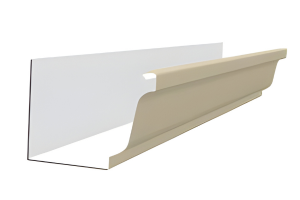
Beige and white rain gutter section.

The K gutter is by far the most common gutter type you’ll see on modern residential homes. It’s easy to identify by its shape: it has a flat back that sits flush against your house and a curved, decorative front that gives it a little more style than a plain


K gutters are formed on-site from large rolls of metal coil. That means we can make them in any length, from one foot to 100 feet, completely seamless. Fewer seams mean fewer opportunities for leaks, which is always a win when it comes to water managmemnt


These gutters typically come in two sizes: 5-inch and 6-inch widths, depending on how much water your roof needs to handle.


Installation – Simple and Secure

K gutters use what’s called a hidden hanger system. You won’t see any brackets from the ground — these hidden hangers clip into the gutter, hook onto the fascia board, and are secured with a screw. It’s an efficient, low-profile way to install gutters that keeps everything snug and sturdy.

What is a Half Round Gutter?

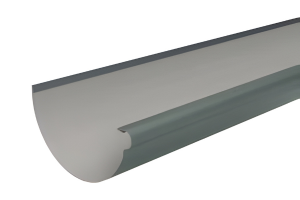
Gray half-round gutter section against a white background.

Half round gutters, as the name suggests, are shaped like a half-circle. They offer a classic, timeless look and are especially popular on older or historic homes, or on homes where the architectural style leans more traditional.


Unlike K gutters, half round gutters are usually installed in 20-foot sections and require a few more components. The gutter itself hangs in a rounded bracket that’s mounted to your fascia board. The installation process takes a bit more time and effort, and the materials tend to be more expensive.


But the payoff is a beautiful, elegant system that adds to the charm of your home.

Which Gutter is Right For You?

Both K gutters and half round gutters are effective at channeling rainwater and protecting your home from water damage. Here’s a quick summary:


  • K Gutters: Affordable, simple to install, low maintenance, and perfect for most single-family homes.


  • Half Round Gutters: Aesthetic, historic look with more involved installation and a higher price tag.


If your home has a traditional or historic design, or you’re going for a high-end look, half round gutters might be the way to go. But for most homes, K gutters are a reliable and budget-friendly choice.

Need Gutter Service?

At Joyland Roofing, we offer complete gutter services — from full installations and replacements to repairs and custom downspout systems. Whether you’re updating your home or need help figuring out what kind of gutter system you need, we’re here to help.


Contact us today for expert advice and a free estimate.

By John Esh February 11, 2026
If your roof is building an ice dam here in Central PA, this guide gives you quick steps you can take right now and a clear explanation of how to prevent it in the future. Quick Actions For Active Leaks If you have a leak under an ice dam, here’s what you can do right away. • Get a bucket under the drip if you can access the crawlspace or attic. • Knock down heavy icicles using a broom or long pole to reduce gutter weight. • Remove as much snow from the roof as you can using a snow rake. • Use Calcium Chloride, not salt. You can fill old socks or hose with it and place them across the ice dam to melt channels. • Avoid metal tools like chisels or hammers. They will damage shingles and gutters. If you can’t safely reach the roof, call a roofer. Just make sure they aren’t planning to chop or smash the ice. That always makes things worse. What Causes An Ice Dam? Ice dams happen because your roof deck gets warm even while the outside air is freezing. Heat escapes from your house into the attic, warms the roof deck, melts the snow, then the meltwater runs downhill and refreezes at the cold eaves. That refreeze is the “dam.” This repeats in a loop. Warm air escapes. Snow melts. Meltwater flows. It hits the cold eaves. It freezes. It builds a ridge. The ridge traps water. The trapped water backs up under shingles and causes leaks. Should You Remove The Ice Dam Or Wait? If there’s no leak and the dam is small, and the snow is mostly off the roof, you can usually wait for a warm-up. If any of these are true, you should get it removed quickly: • You already have a leak • The ice dam is large • There’s a lot of snow on the roof • The forecast stays below freezing for several days Gutters around Central PA are typically rated for 40 to 50 pounds per foot. Ice weighs about 57 pounds per cubic foot. It adds up fast and can pull gutters right off the house.

Person on a shingled roof, text:
By John Esh January 4, 2026
Search Blog
Person in protective eyewear drawing plans, with Joyland Roofing logo and “All About Permits” text.
By John Esh January 4, 2026
Search Blog